pico🙄.sol

Solana validator & picoSOL LST

Settings

Language

Priority Fee (SOL)
    SOL
RPC endpoint
  • picoSOL
  • Blog
  • Stake
  • Company

pico🙄.sol

picoSOLBlogStakeCompany

©pico🙄.sol

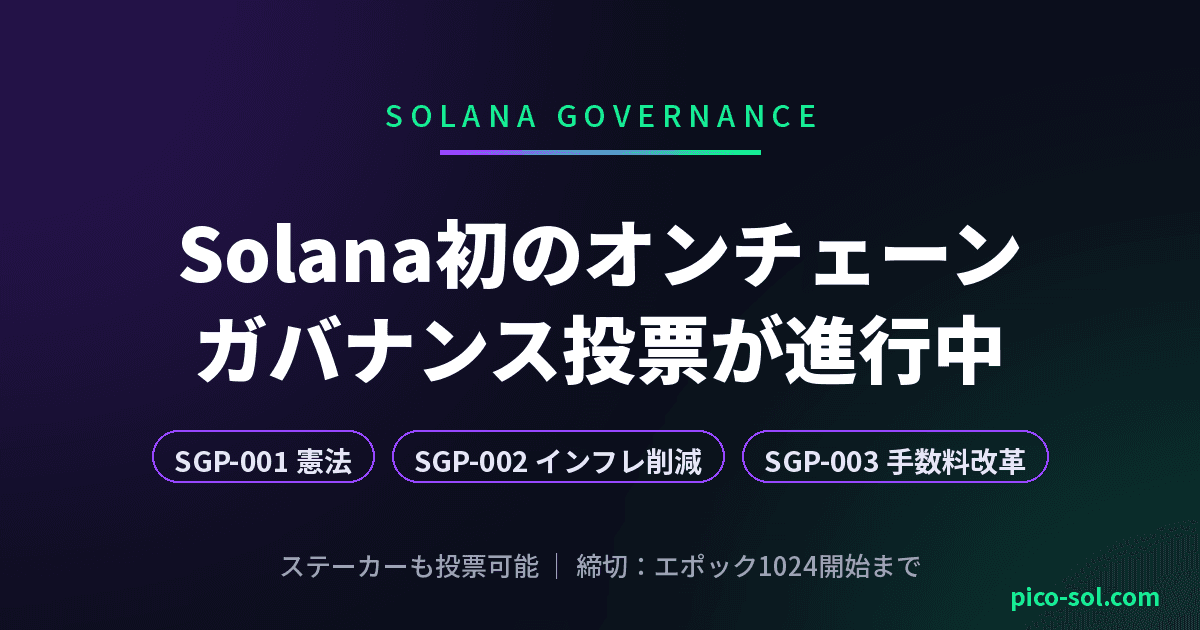
Solana's First On-Chain Governance Vote Is Live — SGP-001 to 003 Explained, and How Stakers Can Vote

Solana's First On-Chain Governance Vote Is Live — SGP-001 to 003 Explained, and How Stakers Can Vote

picoSOL Logo

pico🙄.sol

2026-08-24

Category: Guide
Tags: SolanaGovernanceSGPStaking

Solana's First On-Chain Governance Vote Is Live — SGP-001 to 003 Explained, and How Stakers Can Vote

Introduction: what is happening?

Since August 23, 2026 (epoch 1021), the first on-chain vote under Solana's new governance process, SGP (Solana Governance Proposal), has been underway. Three proposals are on the ballot:

  • SGP-0001 "The Solana Constitution" — ratifying the "constitution" that underpins governance
  • SGP-0002 "Double Disinflation" — accelerating the reduction of SOL inflation
  • SGP-0003 "Resource and Inclusion Fee" — redesigning transaction fees

Solana has held validator votes before, such as SIMD-0228 (inflation reform) in March 2025. What makes this round groundbreaking is that, through a dedicated on-chain program (svmgov), not only validators but stakers themselves can vote directly with their own stake. Even if the validator you delegate to has already voted, you can "override" the vote for your own stake.

The voting deadline is the start of epoch 1024 (around August 29, Japan time). This article explains the three proposals and how to vote.

How the new governance process works

First, let's go over the basic rules of the newly introduced governance process (all figures come from the constitution included in SGP-0001).

  • Stake-weighted voting: each staked SOL counts as one vote. Unstaked SOL has no voting power
  • Delegator vote override: a validator votes on behalf of all stake delegated to it, but delegators can override the vote for their own stake accounts according to their own will. This is possible both before and after the validator votes
  • Voting period: 3 epochs (about 6 days). Before that comes a 7-epoch review period and a stake snapshot (1 epoch) that determines voting power
  • Passing conditions: at least 1/3 of the network's total stake must participate (quorum), and at least 2/3 of participating stake must vote in favor
  • If quorum is not reached: the result is "Inconclusive" rather than "rejected", and is treated as a signal of network apathy

SGP-0001 "The Solana Constitution" — a constitution for governance

This is a vote on whether to ratify the "Solana Constitution", which defines the rules for network-level decision-making on Solana. It was drafted by Jito, Multicoin Capital and others, and the stake-weighted voting and delegator override rights described above are codified in this constitution.

If approved by a majority, the constitution becomes the official "reference document" for Solana governance. It is not a proposal involving technical changes, but a vote on the governance framework itself going forward.

SGP-0002 "Double Disinflation" — faster inflation reduction

This proposal doubles the disinflation rate, the pace at which SOL's inflation rate falls each year, from 15% to 30% (technical specification: SIMD-0550). The key points:

  • The terminal inflation rate of 1.5% is unchanged. The time to reach it shortens from about 5.7 years to about 2.8 years
  • An estimated 18.9 million SOL less will be issued over the next 6 years
  • The staking reward mechanism itself is unchanged, but because issuance falls, nominal APY will decline sooner

On the impact for stakers: inflation-based staking rewards are essentially a "wealth transfer from non-staking holders to stakers (compensation for dilution)", so lower issuance is roughly neutral in terms of ownership share. Nominal APY goes down, but dilution goes down by the same token. On the other hand, for validators that depend on commission income (especially smaller ones), it reduces SOL-denominated revenue. Like SIMD-0228, which was rejected in 2025, this is a topic on which validators tend to be divided.

SGP-0003 "Resource and Inclusion Fee" — fee redesign

This proposal restructures the current fixed base fee (5,000 lamports per signature, half burned and half to the block leader) into two components (technical specification: SIMD-0553).

  • Inclusion fee (fixed, 2,500 lamports): goes entirely to the block leader. A fee for getting your transaction included
  • Resource fee (variable): proportional to the compute resources the transaction requests (compute units, etc.), and burned entirely. The rate is raised in stages: 1/10 → 1/4 → 1/2 lamport per CU

It is often misunderstood as "fees go up during congestion", but that is not the case. It is "fair pricing of resources": transactions that demand heavier processing pay more (lightweight transactions may actually become cheaper than today). The priority fee mechanism is unchanged.

Estimates put SOL burn at roughly 7,500 to 9,000 SOL per day at the final rate (about 12 to 14 times), up from about 648 SOL per day today, which is a supply-side tailwind for holders. On the other hand, apps and bots that set their compute budget carelessly will see a large increase in fees, so ecosystem adaptation has been pointed out as a challenge.

Current vote status (as of August 24, 16:00 JST, on-chain data)

Here is the tally at the time of writing, read directly from the proposal accounts of the svmgov program.

  • SGP-0001: For approx. 23.16M SOL (100%) / Against 0
  • SGP-0002: For approx. 25.64M SOL (96.2%) / Against approx. 0.88M SOL (3.3%) / Abstain approx. 0.14M SOL
  • SGP-0003: For approx. 25.50M SOL (97.8%) / Against approx. 0.59M SOL (2.2%)

All three proposals have overwhelming support early on, but the biggest hurdle is quorum, not the approval rate. Passing requires participation of 1/3 of the network's total stake (over roughly 140M SOL), and current participation is about 26M SOL, under 20% of what is needed. If participation does not grow, all three proposals will be "inconclusive" regardless of the approval rate. This is exactly why the call "Make your vote count!" is going around.

How stakers can vote

Vote from the web (recommended)

  1. Go to governance.solana.com/proposals and open the proposal you want to vote on
  2. Connect your wallet. It must be the wallet that holds the withdraw authority of your stake account
  3. Choose For / Against / Abstain and vote. You can also split your stake across multiple options

The conditions for voting are as follows.

  • A native stake account currently delegated to a validator
  • The stake was active at the snapshot (epoch 1020). Staking newly now does not give you voting power for this round
  • You can override whether or not your validator has voted. If it has not voted yet, your vote is recorded and automatically applied when the validator votes
LST holdings such as picoSOL cannot vote directly

By design, only the withdraw authority of a stake account can sign a vote. Holdings via stake pools and liquid staking (including picoSOL) have no individual stake account, so they are not eligible for direct voting. Only native stake can vote in this round.

Vote from the CLI

For command-line users, there is also the official CLI (svmgov). See the official documentation for details.

svmgov cast-vote-override \
  --proposal-id <proposal PDA address> \
  --for-votes 10000 --against-votes 0 --abstain-votes 0 \
  --stake-account <your stake account> \
  --vote-account <vote account of the validator you delegate to> \
  --staker-keypair ~/.config/solana/staker.json \
  --network mainnet

Schedule

  • Voting starts: epoch 1021 (August 23, 2026, 12:47 JST)
  • Voting period: 3 epochs, 1021 to 1023
  • Deadline: the start of epoch 1024 (around August 29, Japan time)

Epoch timing varies, so check the exact time remaining at governance.solana.com.

Summary

  • The first on-chain vote under Solana's new SGP governance process is underway. Its defining feature is that stakers can vote themselves and override their validator's vote
  • SGP-0001 ratifies the constitution, SGP-0002 accelerates inflation reduction, and SGP-0003 redesigns fees
  • Early approval rates exceed 90% for all three, but passing requires participation of 1/3 of all stake (quorum), and participation is still far short
  • The deadline is the start of epoch 1024 (around August 29). Native stakers can vote by connecting a wallet at governance.solana.com

Your stake can be the vote that decides Solana's future.

References

  • Solana Governance (official, vote here)
  • SGP proposal texts (GitHub)
  • SIMD-0550: Double Disinflation Rate
  • SIMD-0553: Base Inclusion and Resource-based Fee
  • svmgov official documentation (CLI steps)
This page is for informational purposes only and does not constitute investment advice, solicitation, or recommendation. The picoSOL token is a liquid staking token (LST) on the Solana network issued and managed by the Singapore-based project Sanctum. We act solely as a validator receiving delegation from picoSOL and are not involved in its issuance or management. There is no offering or solicitation of picoSOL to residents of Japan. Actual returns and prices may fluctuate due to network conditions and other factors, and past performance does not guarantee future results. Additionally, technical risks—such as smart contract vulnerabilities or network outages—may impair asset value. We assume no responsibility for any losses arising from the content of this page. Please fully understand the risks involved and use this information at your own discretion.

pico🙄.sol

picoSOL Logo

We operate the pico🙄.sol Solana validator.

Search

Links

  • Home
  • Articles

Latest articles

  • Solana's First On-Chain Governance Vote Is Live — SGP-001 to 003 Explained, and How Stakers Can Vote
  • What Is DoubleZero? — The N1 Network That "Redefines the Internet Itself"
  • The Internet Capital Markets (ICM) Roadmap
  • What Is LST Multiply on Kamino Finance?
  • Moonwalk Fitness — Walk to Earn, Lose Out If You Slack

Categories

Guide (5)News (1)

Tags

Anza (1)Campaign (1)DeFi (2)DoubleZero (1)GameFi (1)Governance (1)Healthcare (1)How to use picoSOL (1)IBRL (1)Kamino (2)LST (1)Moonwalk (1)SGP (1)Solana (1)Solana Labs (1)Staking (1)

Monthly archive